Press Release
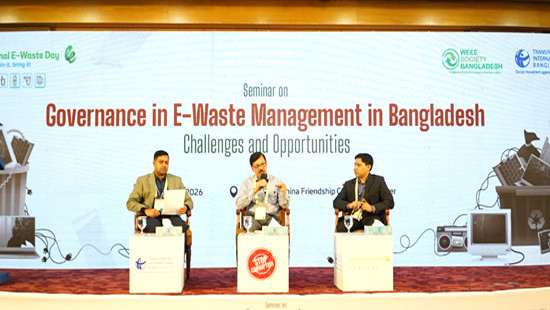
Dhaka, 14 October 2026: Transparency International Bangladesh (TIB) has expressed deep concern that due to a major deficit in governance, weak enforcement of regulations, and a lack of coordination among relevant government and private agencies, the e-waste management sector has fallen captive to informal and unregulated actors. These observations were highlighted during a day-long seminar titled "Governance in E-Waste Management in Bangladesh: Challenges and Opportunities," jointly organized by TIB and WEEE Society Bangladesh at the Bangladesh-China Friendship Conference Centre to mark International E-Waste Day 2026. TIB warned that unless transparency, accountability, and strict compliance with legal frameworks are ensured, the mounting e-waste crisis will inflict irreversible damage on public health and the environment.
The inauguration of the seminar was attended by Dr. Md. Saimum Parvez, Special Assistant to the Prime Minister on Environment, Forest and Climate Change, as the Chief Guest. TIB Executive Director Dr. Iftekharuzzaman and WEEE Society Bangladesh Chairperson Sumon Ahmed Sabir were present on the occasion. Key findings from TIB's research on governance in e-waste management were presented by Abdullah Jahid Osmani, Research Associate at TIB. The study revealed that Bangladesh lacks a national inventory or database to track the volume of e-waste generated and recycled. Consequently, approximately 97 percent of generated e-waste is processed within the informal sector without administrative oversight or regulatory monitoring.
Highlighting the government's stance on addressing the crisis, Chief Guest Dr. Md. Saimum Parvez stated, “The ongoing environmental crisis cannot be ignored under any circumstances. The present government has prioritized governance and environmental protection, setting targets to implement the 3R (Reduce, Reuse, Recycle) policy.” He added that steps are being taken to establish e-waste recycling hubs and material recovery centers at district and divisional levels. He also stressed encouraging investment to manage e-waste originating from electric vehicles and renewable energy systems, while emphasizing the imperative of reflecting stakeholder feedback in relevant policy formulations.
Emphasizing the urgency of institutionalizing e-waste management, TIB Executive Director Dr. Iftekharuzzaman said, “Due to governance deficits and the absence of effective enforcement of proper regulations, this critical sector remains held hostage by informal and unregulated entities. TIB has prioritized this sector as part of its long-term struggle to establish governance and transparency in environment and climate change issues. It is crucial to define the responsibilities of every stakeholder through legal and institutional reforms and to curb illicit transactions. Our main goal is to bring waste management under a sustainable, institutional governance structure.”
The panel discussions, moderated by Dr. Nabil Haq, Coordinator of TIB's Environment and Climate Finance Division, featured representatives from the Department of Environment, telecom, and ISP sectors, as well as domain experts who shared ground realities and sectoral limitations. According to information presented at the seminar, despite the existence of the Hazardous Waste (E-Waste) Management Rules 2021 and BTRC guidelines, the submission rate of regular reports by licensed entities remains extremely low due to weak monitoring and inter-agency coordination gaps. Furthermore, despite existing bans, second-hand and reusable electronic equipment continues to be imported. There are also allegations of exporting e-waste beyond approved limits and unauthorized financial transactions.
Panelists noted that the absence of accurate baseline data or an inventory complicates the monitoring process. Telecom and ISP sector representatives mentioned that although opportunities for network optimization and equipment reuse exist, there are no specific guidelines for field-level e-waste management. They also highlighted a severe lack of inter-ministerial coordination regarding the large volume of electronic items and e-waste originating from the ship-breaking industry. Discussants underscored the need to eliminate overlapping jurisdictions between the Department of Environment and BTRC, bring the informal sector into a structured framework, and ensure Extended Producer Responsibility.
To resolve the existing chaos, TIB presented several recommendations. Among these are: formulating a National E-Waste Inventory; ensuring Extended Producer Responsibility (EPR); strengthening transparent and accountable coordination among relevant government agencies, including the Department of Environment and BTRC; and ensuring strict enforcement of existing laws.
Media Contact:
Mohammad Tauhidul Islam
Director, Outreach and Communication
Phone: +8801713107868
Email: tauhidul@ti-bangladesh.org