Press Release
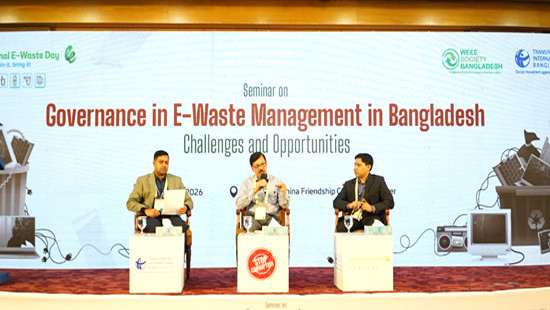
Chattogram, 21 May 2026: Transparency International Bangladesh (TIB) has observed that electronic waste (e-waste) management in Bangladesh is currently mired in acute policy weaknesses and near-total governance anarchy. This concern was raised during a stakeholder seminar held today in Chattogram, where TIB presented its recently published research report titled "E-Waste Management in Bangladesh: Challenges to Good Governance and the Way Forward." The organisation noted that while the volume of toxic e-waste generated from discarded electronic products across the country is rising at an alarming rate, there exists a severe deficit of both policy direction and good governance in its proper management.
The seminar, organised in collaboration with the Committees of Concerned Citizens (CCC), Chattogram, was attended by TIB Executive Director Dr Iftekharuzzaman, CCC Chattogram President Engineer Md Delwar Hossain Mazumder, TIB Coordinator of the Environment and Climate Finance Division Dr Nabil Huq, and Research Associate Abdullah Zahid Osmani. The key findings and recommendations of the research report were presented by Abdullah Zahid Osmani. The presentation revealed that approximately 97 per cent of all e-waste generated in the country is processed through the informal sector using environmentally harmful methods, entirely without administrative oversight, while only 3 per cent falls under formal and safe recycling processes. The seminar, moderated by Dr Nabil Huq, included an open discussion and question-and-answer session on the findings and recommendations of the research. Officials from the Department of Environment, Chattogram City Corporation, District Administration, Chattogram Range DIG Office, Port Authority and the Customs House participated in the seminar, alongside leaders of the Chattogram Chamber of Commerce, representatives of the ship-breaking industry, local civil society members and media professionals, each of whom shared the ground realities and constraints of their respective sectors.
Noting that the failure to properly manage end-of-life devices will soon plunge the country into a serious crisis, CCC Chattogram President Engineer Md Delwar Hossain Mazumder said, "E-waste collection in the country is entirely unregulated and its recycling takes place through highly risky and informal means, causing severe environmental pollution and extreme health risks to workers. The risks of e-waste must be treated as a consolidated concern encompassing worker safety, urban management and good governance, not merely as an environmental or public health issue. It is not enough to simply formulate policies; institutional capacity must also be strengthened to ensure their implementation."
Highlighting the need for coordinated initiatives by public and private stakeholders to address e-waste risks, TIB Executive Director Dr Iftekharuzzaman said, "Globally, progress in e-waste management has lagged far behind what is required, with less than a quarter of the e-waste generated worldwide managed or recycled through proper processes. Awareness is certainly necessary, but those who hold responsibility for state governance and institutional duty cannot evade accountability when it comes to effective policy implementation. We are hopeful that through the collective awareness and effective participation of all stakeholders, it will be possible to transform the e-waste crisis into an opportunity and build a safe and liveable environment."
According to the research report, published on 30 December 2025, although the Hazardous Waste (E-Waste) Management Rules 2021 assign responsibilities to various stakeholders for e-waste management in Bangladesh, implementation has remained negligible. None of the mandated measures, including the establishment of e-waste collection centres by electronic equipment manufacturers and importers, the creation of dedicated funds, or public awareness campaigns, have been implemented. There are likewise no policies governing the sale or use of old electronic equipment sourced from the ship-breaking industry in Chattogram, and no plan has yet been adopted for managing e-waste arising from electric vehicles, solar panels, battery-operated toys, drones and similar devices.
To address the prevailing state of disorder, TIB has put forward a 12-point set of recommendations. These include halting illegal import and export through strict enforcement of e-waste rules and the Basel Convention; eliminating corruption by strengthening the capacity of regulatory bodies and digitising the clearance and registration processes; ensuring information transparency by introducing a one-stop service through coordination between BTRC and the Department of Environment; and promptly formulating a long-term "E-Waste Roadmap" to address waste from solar panels and electric vehicles.
Media Contact:
Mohammad Tauhidul Islam
Director, Outreach and Communication
Phone: +8801713107868
Email: tauhidul@ti-bangladesh.org