Published: 05 February 2026
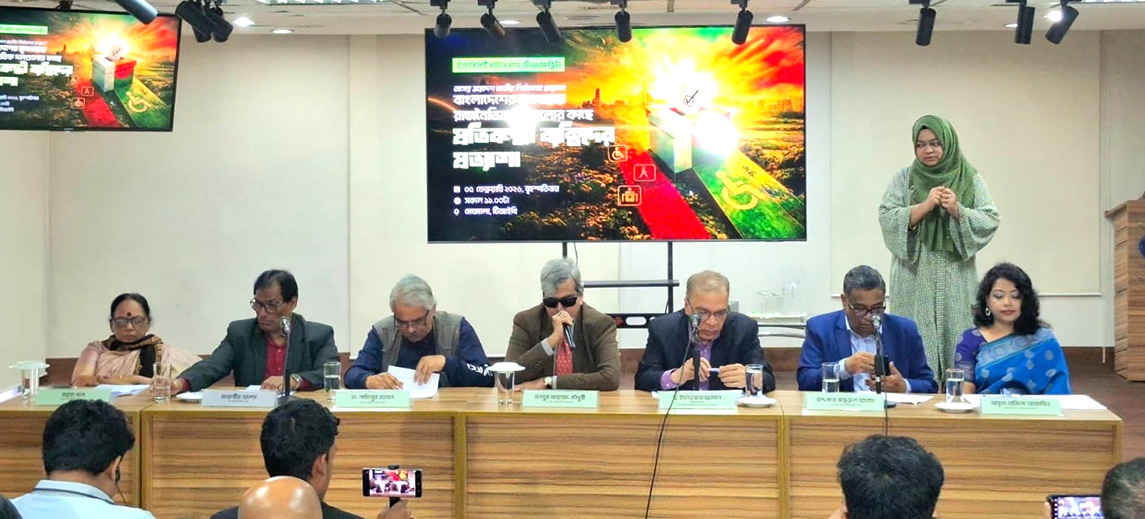
"I am very excited about this year's election; I heartily want to choose a worthy representative through the ballot. But, despite being a citizen of this country, the path to voting is quite difficult for me. I cannot hear, nor can I speak—how will I communicate at the polling station? The fear of facing an unpleasant or embarrassing situation haunts me. If I were allowed to have an interpreter with me in the polling booth, perhaps I could express my thoughts. However, a lot of people, including myself, cannot personally bring an interpreter to cast votes. Does the government consider our needs at all? Will our rights and participation be neglected this time as well, as always?" Abdullah, a person with hearing and speech disabilities, shared these words at a press conference titled "Expectations of Persons with Disabilities from the Mainstream Political Parties of Bangladesh" regarding their participation and protection of rights in the upcoming elections.
A press conference organized by Disability Rights Watch (DRW) in partnership with Transparency International Bangladesh (TIB) explicitly highlighted the political and constitutional rights of individuals with disabilities to the government, the Election Commission, and political parties.
As the country prepares for the 13th National Parliamentary Election, it is crucial to ensure the participation of a large population. They are citizens of this country, yet exercising the civic right to vote for their preferred representative at the polling station has become structurally challenging for them. Just when the people expect a fair, neutral, and participatory election after many years, the voting of a large portion of them remains uncertain. Despite demands made to the government, the Ministry of Social Welfare, and the Election Commission to take necessary measures to ensure the voting rights of persons with disabilities, and to receive assurances, no effective initiatives have been observed with only 8 days left for the election.
The necessity of safeguarding the rights of persons with disabilities throughout the pre-election, election, and post-election phases was emphasized in a concept paper presented by DRW’s inclusion expert, Dr. Nafeesur Rahman. Despite the ratification of the UN Convention on the Rights of Persons with Disabilities (CRPD) in 2007 and the passing of a local law in 2013, its implementation remains stalled. According to the World Health Organization, 15 percent of any population are persons with disabilities, and by that account, this number exceeds 20 million in Bangladesh. Yet, there are insufficient initiatives for the development of such a huge population. Currently, since disability issues are limited only within the scope of the Ministry of Social Welfare, persons with disabilities are becoming victims of deprivation in fields like education, health, or employment.
Mohua Paul, Chairperson of Access Bangladesh Foundation, underscored the assessment of women with disabilities in the forthcoming election and called for polling stations to be specifically accessible to them. On the other hand, DRW member Jahangir Alam, based on his experience, said that as a person with visual impairment, he hopes they can vote safely and maintain secrecy. He mentioned that it is essential to approve a guide to accompany visually impaired persons to ensure this. Amrita Rejina Rozario, the Country Director of Sightsavers Bangladesh, expressed apprehension regarding the assessment of the quality of life of persons with disabilities. She urged the winning government to guarantee job opportunities and skill development for individuals with disabilities, in addition to establishing specific indicators. The next government should adopt a "inclusive approach," according to Khandaker Jahurul Alam, Executive Director of the Center for Services and Information on Disability (CSID).
Monsur Ahmed Chowdhury, president of DRW and chairperson of the Board of Trustees of TIB, called upon journalists to play an active role at the press conference. He said, "You should ask the Election Commission and political parties what their plans are. The Commission must take swift action according to their commitments, and political parties must give importance to persons with disabilities in their manifestos."
TIB Executive Director Dr. Iftekharuzzaman stated at the conclusion of the event, "A fair, neutral, and participatory election is not feasible without prioritizing the participation of a significant portion of society, although a movement has been undertaken to establish a society free of discrimination through significant sacrifice, blood, and life." In addition to guaranteeing a level playing field for candidates in the election, it is essential to make sure that voters are also treated fairly. To ensure that all persons with disabilities have the opportunity to participate in the election, the issues outlined in the DRW concept paper must be addressed. An action plan must be implemented to guarantee the equal rights of individuals with disabilities following the election.