Press Release
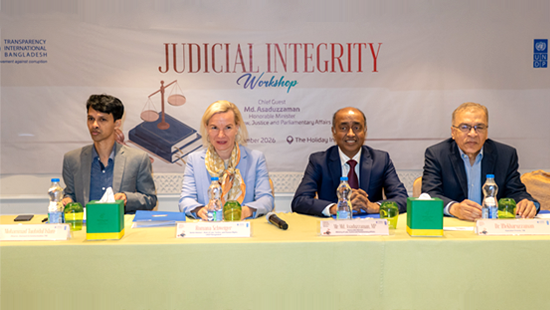
Dhaka, 8 November 2026: Establishing the envisioned judicial system in Bangladesh requires impartiality, freedom from all forms of corruption, including intellectual and financial corruption, and ensuring visible justice for the people. To achieve this, integrity and ethical standards must be ensured across the country’s existing political, bureaucratic and institutional ecosystem. Speakers made these remarks at the inaugural session of a three-day (8–10 November) workshop titled ‘Integrity in Judicial Proceedings’, organised by Transparency International Bangladesh (TIB) in collaboration with the United Nations Development Programme (UNDP).
The inaugural event was held today, Sunday, at Hotel Holiday Inn in Tejgaon, Dhaka. The Chief Guest was Mr Md Asaduzzaman, MP, Minister for Law, Justice and Parliamentary Affairs of the Government of the People’s Republic of Bangladesh. Ms Romana Schweiger, Senior Advisor on Rule of Law, Justice and Human Rights at UNDP Bangladesh, attended as the Special Guest. The event was chaired by Dr Iftekharuzzaman, Executive Director of TIB. Also present were Muhammad Badiuzzaman, Director of TIB’s Research and Policy Division, and Mohammad Tauhidul Islam, Director of its Outreach and Communication Division.
In his introductory remarks, Dr Iftekharuzzaman said, “Judicial integrity is essential for a people-centred, justice-based and accountable state. Public trust and respect for the courts depend on the integrity and ethical conduct of judges. Upholding the fundamental principle of the rule of law - that everyone is equal before the law and that justice must be delivered free from any partisan political or financial influence- requires judicial integrity. However, as a consequence of decades of unhealthy politics in Bangladesh, political and bureaucratic influence has become normalised in the judiciary, as in almost all other professions and institutions. The judicial system, and judicial integrity in particular, are part of the country’s broader political, bureaucratic and institutional ecosystem. Therefore, the extent to which this ecosystem- both its political and bureaucratic structures and other state institutions- can progress towards integrity and ethical standards, individually and collectively, will determine the extent to which judicial independence, impartiality and integrity can be achieved.”
Delivering a goodwill message from Mr Stephen Rodriques, UNDP Resident Representative in Bangladesh, Ms Romana Schweiger said, “This workshop has been organised as part of the ongoing partnership between UNDP and TIB to build an independent, accountable and people-centred justice system in Bangladesh.” Describing judicial integrity as the foundation for independent judicial decision-making and the right to impartial justice, she said, “Upholding judicial integrity means ensuring that every decision is based solely on the law. The rule of law sustains public confidence in the administration of justice. Several important reform initiatives are currently underway in Bangladesh’s judiciary. We believe that the opportunities and enabling environment for improving the judiciary as a whole and strengthening its ethical standards have never been greater. Although a framework on judicial independence and integrity already exists, it needs to be gradually updated to address the challenges of the present time.”
In his address as Chief Guest, Law Minister Md Asaduzzaman said, “The problem of integrity in Bangladesh’s judicial system should not be viewed solely from a financial perspective; it must also be examined from an intellectual perspective. Intellectual corruption has caused greater damage to the judiciary than financial corruption.” Raising questions about the extent to which the higher judiciary had stood alongside the people during periods of crisis and when confronted with the government in previous years, the Minister said, “When verdicts such as the one concerning the Fifteenth Amendment were delivered, and the process of destroying Bangladesh’s democratic progress and steering the country towards fascism was initiated through the higher judiciary, these developments cannot simply be described as by-products of financial corruption. The Fifteenth Amendment verdict was a product of intellectual corruption.”
Emphasising the government’s commitment to establishing a separate secretariat for the judiciary and ensuring judicial independence, he further said, “We are working to ensure transparency in the judicial system through constitutional amendments. We want a judicial system where justice is delivered impartially, free from intellectual corruption, and in a manner visible to the people.” The Minister also pledged to consider any substantive and people-oriented recommendations from TIB regarding constitutional reforms in the judiciary, provided they are submitted in writing within the next ten days.
Following the inaugural session, the first day’s sessions of the three-day workshop were conducted by Professor Dr M Shawkat Alam, a faculty member specialising in International and Environmental Law at Macquarie Law School, Macquarie University, Australia. The training will continue until 10 November. A total of 25 judges from subordinate courts across the country, nominated by the Law and Justice Division with the approval of the higher judiciary, are participating in the workshop.
Media Contact:
Mohammad Tauhidul Islam
Director, Outreach and Communication
Phone: +8801713107868
Email: tauhidul@ti-bangladesh.org